What It Actually Costs to Live in Mérida as a Canadian (2026)
Mérida catches people off guard. You come expecting a cheap Mexican city and find a colonial capital with more cultural depth than most people are prepared for — Mayan heritage that’s not just in museums but in the food, the language, and the faces of the families who’ve lived here for centuries. The fact that it’s also one of the most affordable places a Canadian can live well? That’s the bonus, not the point.
But since you’re here for the numbers, here they are: a comfortable mid-range life in Mérida costs about $1,900 CAD a month. For context, that’s less than rent alone on a one-bedroom in Toronto. And Mérida is consistently rated one of the safest large cities in Mexico.
All figures below are in Canadian dollars.
This post contains affiliate links. We may earn a commission at no extra cost to you.
All figures in CAD. Based on early 2026 data. Exchange rates fluctuate — verify before making financial decisions.
The Monthly Numbers
| Expense | Budget (CAD/mo) | Mid-Range (CAD/mo) | Comfortable (CAD/mo) |
|---|---|---|---|
| Furnished 1BR apartment | $400-650 | $650-1,000 | $1,000-1,500 |
| Food (groceries + dining) | $200-350 | $350-500 | $500-750 |
| Transportation (bus + taxi/Uber) | $20-50 | $50-100 | $100-200 |
| Health insurance (private) | $60-120 | $120-200 | $200-350 |
| Utilities (electric, water, gas, internet) | $60-120 | $100-160 | $140-220 |
| Phone (prepaid SIM) | $10-20 | $15-25 | $20-35 |
| Entertainment / social | $60-150 | $150-280 | $250-400 |
| Domestic help (optional) | — | $40-80 | $60-120 |
| Total | $810-1,460 | $1,475-2,345 | $2,270-3,575 |
The electricity warning: Notice utilities are higher than you’d expect for an affordable city. That’s air conditioning. Mérida sits on the Yucatán Peninsula at sea level, and temperatures regularly hit 35-40°C with humidity. Running A/C 8-12 hours a day is normal. CFE (Mexico’s power company) uses tiered pricing — heavy use pushes you into higher rate brackets. Budget $80-200 CAD/month for electricity alone in peak summer. Ask about electricity costs before signing any lease.
What That Looks Like Next to Toronto
| Expense | Mérida (Mid-Range) | Toronto (Equivalent) | Monthly Savings |
|---|---|---|---|
| Furnished 1BR | $650-1,000 | $2,200-2,800 | $1,200-1,800 |
| Food | $350-500 | $600-900 | $250-400 |
| Transport | $50-100 | $160-250 | $110-150 |
| Utilities + internet | $100-160 | $150-200 | $50-40 |
| Total | ~$1,900 | ~$4,200 | ~$2,300/mo |
A Canadian couple receiving combined CPP and OAS of $2,800-3,500/month can live comfortably in Mérida with money left over. That’s a sentence most people in Toronto haven’t been able to say about their own city in a long time.
Where to Live: Choosing Your Mérida
Mérida is a city of about a million people, and it was here long before anyone used the word “expat.” The Mayan civilization built this region; the Spanish colonial architecture came later; the expat arrivals are the newest chapter. The neighbourhoods below each offer something different, but the best experience comes from choosing one where you’ll actually get to know the community — not just the other Canadians.
Centro Histórico — Colonial Heart, Living Culture ($500-1,000 CAD)
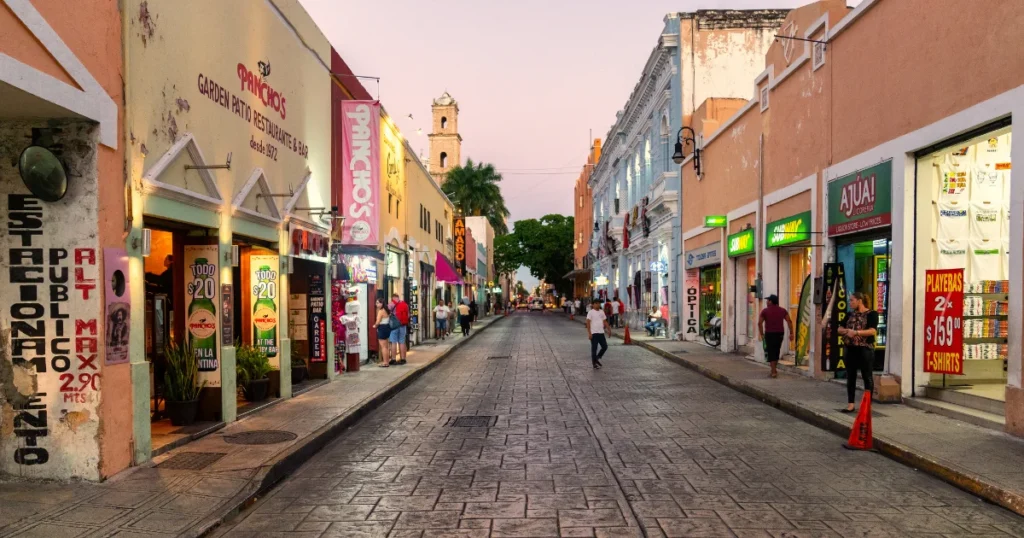
Mérida’s historic centre is extraordinary. Colourful colonial mansions line the streets around the main plaza. The cathedral — one of the oldest in the Americas — anchors a neighbourhood that hosts weekly cultural events, free concerts in the park, and a Sunday market that’s been running for longer than Canada has existed. Many restored homes are available as furnished rentals.
This is the Mérida that Canadians fall in love with on the first visit. It’s also the Mérida where local Yucatecan families still live, where the corner tienda is run by the same family it’s been run by for decades, and where the food — cochinita pibil, papadzules, sopa de lima — reflects centuries of Mayan and Spanish culinary history, not expat-friendly fusion menus. Walking distance to markets, restaurants, and cultural life. The drawback: older buildings can be noisy and poorly insulated (meaning higher A/C costs).
García Ginerés — Practical and Connected ($600-1,100 CAD)
A residential neighbourhood just north of Centro. Modern apartments, good supermarkets (Chedraui, Walmart), clinics, and restaurants. More “working city” than “colonial postcard” — which is exactly what some people want. Good balance of price, convenience, and quiet. The kind of neighbourhood where you pick up a routine fast: morning coffee at the same café, groceries at the same market, nodding hello to the same neighbours.
Santiago / Santa Ana — Community Character ($400-700 CAD)
Two smaller barrios within the historic core. Less polished than the main Centro but overflowing with character — neighbourhood markets, local cantinas with no English spoken, quiet streets where kids play until dark. These barrios have their own churches, their own fiestas, their own identity. Growing in popularity with budget-conscious retirees who value authenticity and community over convenience.
Living here means living in a neighbourhood that’s Mexican first and expat-friendly second. If that appeals to you — and we think it should — Santiago and Santa Ana are the best value in central Mérida.
Altabrisa / North Mérida — Modern Suburban ($700-1,300 CAD)
Mérida’s modern growth corridor. Shopping malls (Gran Plaza, Altabrisa), new condo developments, chain restaurants, and the best hospitals (Star Médica, Hospital Faro del Mayab). This is where Mérida looks most like a North American suburb — and for Canadians who find comfort in familiarity, that’s the draw. You’ll need a car or frequent Uber rides.
Worth noting: much of this development has come at the cost of agricultural land that local Maya communities historically used. It’s modern and convenient, but it’s the part of Mérida with the least connection to the culture that makes this city special.
The Hidden Costs
- Air conditioning electricity: The single biggest hidden cost. CFE uses tiered pricing — heavy A/C pushes you into higher rate brackets. Budget $80-200 CAD/month for electricity alone in summer. Newer buildings with better insulation save meaningfully here.
- Transport: Mérida launched the Va y Ven bus system in 2021, with 70+ routes and fares around $1 CAD per ride using a prepaid smart card (available at OXXO stores). It’s functional and improving, but most expats still rely on Uber ($2-5 CAD per ride, genuinely cheap) or buy a used car. Car ownership adds $150-300 CAD/month for insurance, gas, and maintenance.
- Currency exchange: Use Wise or a proper transfer service — not your Canadian bank’s 2-4% spread. Over a year, the savings are substantial.
- Beach trips: Mérida is 30-40 minutes from the Gulf coast (Progreso, Chicxulub Puerto). The beaches aren’t Caribbean-blue, but they’re real and uncrowded. Budget $5-15 CAD round trip by bus or Uber for weekend runs.
- Flights home: No direct flights from Mérida to Canada — connections through Mexico City or Cancún. Budget $600-1,100 CAD return to Toronto. The extra connection is the trade-off for Mérida’s lower cost of living.
- Domestic help: Common and affordable in Mérida. A weekly house cleaning runs $40-80 CAD/month. Pay fairly. Many expats pay the going rate, but the going rate reflects local wage levels, not the value of the work. Set a rate you’d be comfortable explaining to the person doing the work — someone who may be supporting a family on that income. Pay what the work is worth to you, not just what the market will bear.
What Your Dollar Actually Buys
At $1,200 CAD/month: A basic but clean apartment in Santiago or the southern edge of Centro. Eating at fondas and neighbourhood markets — cochinita pibil from the morning market vendor, tamales from the señora on the corner. Buses and occasional Uber. A modest social budget. Tight but dignified for a single person.
At $2,000 CAD/month: A nice furnished 1BR in Centro or García Ginerés. Mix of home cooking and restaurants — and Mérida’s restaurant scene is genuinely excellent. Uber whenever you want. Weekend trips to Progreso or cenotes. This is the sweet spot for retirees: a comfortable life with financial breathing room.
At $3,200 CAD/month: A spacious apartment or small house in a good neighbourhood. Dining out regularly at Mérida’s best restaurants. Domestic help weekly. Private healthcare at modern hospitals. Day trips to Uxmal, Izamal, and the cenotes. Living exceptionally well in a city with more cultural depth than most people give it credit for.
The Mayan Context
This matters, and most expat guides skip it entirely.
Mérida is the capital of Yucatán state, and the Yucatán Peninsula is the heartland of Maya civilization. The Maya people aren’t historical — they’re contemporary. Mayan languages are spoken daily in the markets and neighbourhoods around you. The food you’re eating, the cenotes you’re swimming in, the ruins you’re visiting — this is a living culture, not a museum exhibit.
The best version of living in Mérida is engaging with this reality. Visit the mercado instead of the supermarket. Try the food that doesn’t have an English name. Learn a few words of Yucatec Maya alongside your Spanish — your neighbours will notice. Support the artisans and craftspeople who make the hammocks, the huipiles, and the pottery by buying directly, not from the tourist markup shops on Paseo de Montejo.
You’re not just getting a cheap retirement. You’re getting invited into one of the oldest continuously inhabited regions in the Americas. The least you can do is show up with curiosity and respect.
The Bottom Line
Mérida is one of the best values in the Western Hemisphere for Canadian retirees. It’s safer than most Mexican cities, cheaper than Puerto Vallarta, culturally richer than you expect, and has a growing community of Canadians who’ll help smooth the transition. The heat is real — but so are the savings, and so is the life you can build here.
For a head-to-head with Mexico City, see our Mérida vs Mexico City comparison for retirees. For the bigger picture, here’s our three-country cost comparison.
Healthcare note: Your provincial health coverage lapses after 6-8 months abroad, and provincial plans don’t pay upfront for foreign medical costs. You need private replacement coverage. Full breakdown in our insurance guide. [Source: Global Affairs Canada.]
Tax note: Non-residents face 25% CRA withholding on Canadian-source income including pensions. Tax treaties may reduce this. Talk to a cross-border tax accountant before you go. [Source: CRA T4058, 2024.]
Download our free Budget Worksheet for Retirees — map your CPP, OAS, and pension income against Mérida expenses and see what your retirement actually looks like here.
Want the full picture? The Mexico Relocation Kit ($59 CAD) covers the Temporary Resident Visa, banking, healthcare, neighbourhoods across Mexico, and a 30-day action plan.
This guide is for informational purposes only. Visa requirements, costs, tax rules, and healthcare policies change — always confirm details with official sources and qualified professionals before making decisions. All costs in CAD unless noted.