5 Cheapest Cities for Canadian Retirees Abroad (2026 Rankings)
By Taraji Abroad
This post contains affiliate links. We may earn a commission at no extra cost to you.
All figures in CAD. Based on early 2026 data. Exchange rates fluctuate — verify costs before making financial decisions.
A one-bedroom apartment in Toronto runs $2,300-2,800 a month. Add groceries, transit, utilities, provincial health premiums, and the occasional dinner that isn’t reheated soup, and a single retiree in the GTA is looking at $4,000-5,500 CAD per month just to exist comfortably. Not lavishly. Comfortably.
Now consider this: the most expensive city on this list costs $3,100 a month — and that includes a furnished apartment, eating out most meals, health insurance, and a lifestyle that would cost twice as much back home.
The cheapest? $1,500 a month. Less than Toronto rent alone.
We ranked five cities across Mexico and Thailand where Canadian retirees are actually living well on modest budgets. Not surviving. Not roughing it. Living the kind of daily life that makes your friends back in Hamilton text you “wait, seriously?” when you send them a photo of your Tuesday lunch.
How We Ranked These Cities
Every ranking on the internet uses different rules, so here are ours:
- Comfortable mid-range lifestyle — a furnished one-bedroom apartment in a safe, well-located neighbourhood. Air conditioning. Reliable internet. Not a hostel, not a luxury villa.
- Eating well — a mix of home cooking, local restaurants, and the occasional nicer meal. No ramen-every-night budgets.
- Health insurance included — because once you leave your province for more than a few months, you’re on your own. We factored in international coverage through providers like SafetyWing.
- Single person — couples can expect 40-60% more, not double.
- CAD figures — because we’re Canadian and tired of converting from USD.
We left out cities that are technically cheap but impractical for retirees (no reliable healthcare), and cities that are great but no longer affordable enough to make a top-5 cheapest list (looking at you, Lisbon).
For the full country-level breakdown, see our Mexico vs Portugal vs Thailand cost comparison.
1. Chiang Mai, Thailand — ~$1,500 CAD/month
| Category | Monthly Cost (CAD) |
|---|---|
| Rent (furnished 1BR) | $400-700 |
| Food | $300-500 |
| Health insurance | $120-200 |
| Transport | $40-100 |
| Utilities + internet | $50-100 |
| Miscellaneous | $100-200 |
| Total | $1,010-1,800 |
Six-thirty in the morning, and the monks are already walking their alms route past your condo. You’re on a third-floor balcony with a view of Doi Suthep — the mountain that watches over everything here — drinking a coffee that cost you twelve baht from the cart downstairs. That’s about forty-five cents. The air is cool because it’s November, and cool in Chiang Mai means you might actually want a light sweater.
Chiang Mai is the most affordable city on this list by a wide margin, and the quality of life matches or exceeds many cities twice the price. The food alone would justify living here — night markets where vendors serve dishes at local prices ($3-4 CAD for a full meal), and the cooking reflects generations of regional tradition from across northern Thailand. A furnished condo in the popular Nimman neighbourhood, with a pool and gym in the building, runs $500-700 a month. The same setup in Toronto would be $2,500+. If you want the line-by-line version, here’s what $1,500 CAD/month buys in each city across Puerto Vallarta, Lisbon, and Chiang Mai.
The catch is real, though. Burning season (February through April) fills the air with smoke from agricultural fires, and air quality can get genuinely dangerous. Many expats leave for the coast during those months. Flights from Canada are 20+ hours with at least one connection. And the time zone difference (12 hours ahead of Eastern) means your family FaceTime window is narrow.
Best for: Adventurous retirees who want maximum dollar stretch and don’t mind being far from home.
Thinking about a local SIM for staying connected? Airalo eSIMs let you land with data already working — no airport kiosk scramble.
Full breakdown: Cost of Living in Chiang Mai for Canadians.
2. Mérida, Mexico — ~$1,900 CAD/month
| Category | Monthly Cost (CAD) |
|---|---|
| Rent (furnished 1BR) | $650-1,000 |
| Food | $350-500 |
| Health insurance | $120-200 |
| Transport | $40-100 |
| Utilities + internet | $80-150 |
| Miscellaneous | $100-200 |
| Total | $1,340-2,150 |
You’re sitting in the courtyard of a colonial house in Centro — high ceilings, tiled floors that have been here longer than Canada has been a country, a ceiling fan turning slowly overhead. Your landlord’s grandmother planted the orange tree in the corner. The fruit is free. You just had cochinita pibil from the market for $4 CAD and you’re trying to explain to your sister in Winnipeg why you’re never coming back.
Mérida is consistently rated one of the safest large cities in Mexico, and it’s roughly 30% cheaper than Mexico City. The Yucatán capital runs on Mayan heritage that isn’t just in museums — it’s in the food, the language, the festivals that shut down entire neighbourhoods on a random Wednesday. The expat community is growing but hasn’t overwhelmed the city the way it has in parts of CDMX or Playa del Carmen.
The catch: it’s hot. We’re talking 35-40°C from April through October, and humidity that makes Toronto in August feel like a walk-in cooler. Air conditioning is not optional — budget for higher electricity bills. Some Spanish helps enormously here; English is less common than in tourist-heavy Mexican cities.
Best for: Culture-loving retirees who can handle the heat and want deep authenticity over beach-resort convenience.
Full breakdown: Cost of Living in Mérida for Canadians.
3. Mexico City, Mexico — ~$2,200 CAD/month
| Category | Monthly Cost (CAD) |
|---|---|
| Rent (furnished 1BR) | $800-1,200 |
| Food | $400-600 |
| Health insurance | $120-200 |
| Transport | $40-80 |
| Utilities + internet | $70-130 |
| Miscellaneous | $120-200 |
| Total | $1,550-2,410 |
Sunday morning in Condesa. The entire neighbourhood is on the street — families, dogs, couples sharing churros, someone playing jazz trumpet on the median of Avenida Amsterdam. You walked twenty minutes to get here from your apartment in Roma Norte, past three cafés you’ll definitely try this week, and the whole scene feels like Montreal crossed with Barcelona and priced like 2005.
Mexico City is a world capital where a comfortable life costs significantly less than Calgary or Toronto. Direct flights from Toronto take about 4.5 hours — shorter than flying to Vancouver. The food scene rivals any city on earth. The climate sits at a permanent spring thanks to 2,240 metres of altitude: warm days, cool nights, no air conditioning needed.
That altitude is also the catch. Some people feel it, especially in the first week — headaches, shortness of breath on stairs. Air quality has good days and bad days. And CDMX is massive (22 million metro), which can overwhelm if you’re used to quieter places. The city rewards you for picking the right neighbourhood and ignoring the rest.
Best for: Urban retirees who want big-city culture, easy flights home, and don’t mind the energy of a megacity.
Sending money from your Canadian accounts? Wise converts CAD to MXN at the real exchange rate — no bank markup.
Full breakdown: Cost of Living in Mexico City for Canadians.
4. Puerto Vallarta, Mexico — ~$2,300 CAD/month
| Category | Monthly Cost (CAD) |
|---|---|
| Rent (furnished 1BR) | $900-1,400 |
| Food | $400-600 |
| Health insurance | $120-200 |
| Transport | $40-80 |
| Utilities + internet | $80-150 |
| Miscellaneous | $120-200 |
| Total | $1,660-2,630 |
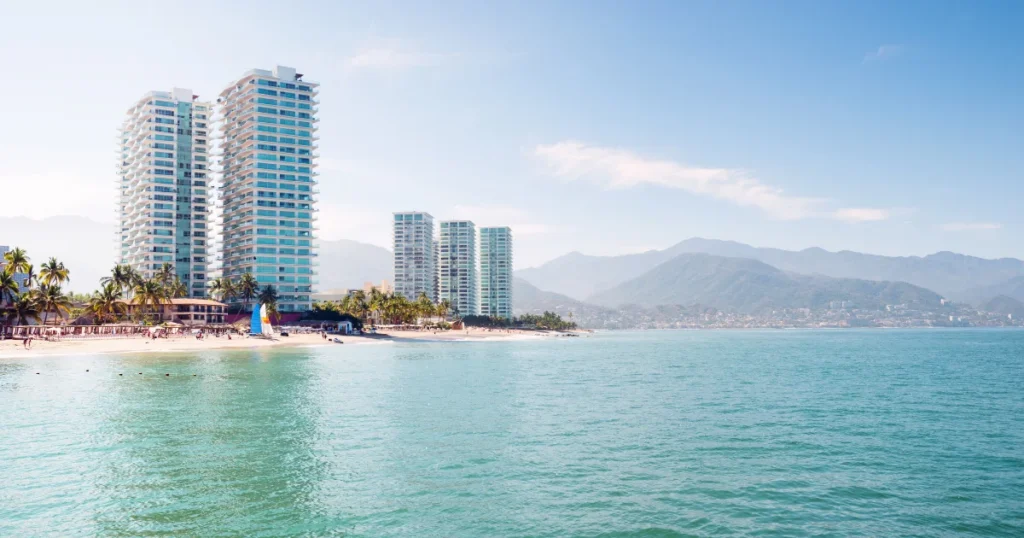
It’s January. Your neighbour back in Barrie just posted a photo of their car buried under forty centimetres of snow. You’re reading it on your phone from a rooftop palapa, watching pelicans dive into Banderas Bay, and your biggest decision today is whether to walk to the malecón for tacos or stay in the pool. You text back a single sun emoji. No words needed.
Puerto Vallarta is the classic Canadian snowbird destination for good reason. Direct flights from Toronto, Calgary, and Vancouver run November through April. The established Canadian and American community means English is widely spoken, familiar brands exist alongside local businesses, and you won’t be the first person your landlord has dealt with who pays in CAD. The beaches are the obvious draw, but the old town — cobblestone streets climbing up into the hills — has genuine Mexican character that resort towns often lack.
The catch is seasonal pricing. Rents in high season (November-April) run 30-50% higher than the rest of the year. If you’re here year-round, you’ll also face a rainy season from May through October — hot, humid, with afternoon downpours. Most snowbirds solve this by leaving in April and returning in November, which is a perfectly good strategy if you have a Canadian home base.
Best for: Classic snowbird lifestyle — beach, community, easy flights, and a rhythm you can repeat every winter.
Full breakdown: Cost of Living in Puerto Vallarta for Canadians.
5. Bangkok, Thailand — ~$3,100 CAD/month
| Category | Monthly Cost (CAD) |
|---|---|
| Rent (furnished 1BR) | $700-2,000 |
| Food | $300-450 |
| Health insurance | $80-300 |
| Transport | $50-120 |
| Utilities + internet | $60-120 |
| Miscellaneous | $150-250 |
| Total | $1,340-3,240 |
You’re on the BTS Skytrain — air-conditioned, spotless, runs every three minutes — gliding above a city that never quite stops moving. Through the window you can see golden temple spires next to glass towers, a rooftop bar lit up on the 50th floor, and somewhere below, a street vendor is grilling satay that smells so good the whole platform knows about it. You paid $1.20 CAD for this ride. In Toronto it would have been $3.35 and the subway would have been delayed.
Bangkok is the most expensive city on this list, but it earns the spot for a reason most retirees care deeply about: healthcare. Bangkok’s private hospitals — Bumrungrad, Samitivej, BNH — are internationally accredited and cost a fraction of Canadian rates. A specialist visit that would take six months to book in Ontario happens here in 48 hours for $40-80 CAD. For retirees managing ongoing health conditions, this alone justifies the premium over Chiang Mai.
The city is also genuinely modern. High-speed internet everywhere, world-class malls, international groceries, a transit system that works, and food so good and so cheap that cooking at home feels like a waste of everyone’s time. The rent range is wide because Bangkok neighbourhoods vary enormously — a condo near the BTS in Ari or On Nut costs half what the same unit costs in Sukhumvit’s tourist core.
The catch: year-round heat and humidity (think Ottawa in August, but every day). The distance from Canada is the same as Chiang Mai — 20+ hours, and the time difference makes staying in touch harder. Visa rules for retirees require navigating Thailand’s retirement visa system, which is doable but involves paperwork and minimum balance requirements.
Best for: Retirees who want city amenities, world-class healthcare, and are comfortable being far from home.
Full breakdown: Canadian Expat Guide to Bangkok.
All Five Cities, Side by Side
| City | Monthly Total (CAD) | Rent Range | Flight from Toronto | Best For |
|---|---|---|---|---|
| Chiang Mai | ~$1,500 | $400-700 | 20+ hrs (connections) | Max dollar stretch |
| Mérida | ~$1,900 | $650-1,000 | ~5 hrs (1 stop) | Culture + safety |
| Mexico City | ~$2,200 | $800-1,200 | 4.5 hrs (direct) | Urban energy, close to home |
| Puerto Vallarta | ~$2,300 | $900-1,400 | 5 hrs (direct, seasonal) | Classic snowbird |
| Bangkok | ~$3,100 | $700-2,000 | 20+ hrs (connections) | Healthcare + city life |
For comparison: a comfortable retirement in Toronto runs $4,000-5,500 a month. Every city on this list is cheaper — and the top three cost less than Toronto rent alone.
The Canadian Pension Math
Here’s where it gets interesting for anyone relying on government pensions.
CPP (Canada Pension Plan) pays an average of roughly $800-900 CAD per month, with the maximum around $1,365 in 2026 (most people get less than the max). OAS (Old Age Security) adds approximately $700-730 per month for those 65+. Combined, a typical Canadian retiree receives somewhere between $1,300 and $2,100 CAD per month from government pensions alone.
Both CPP and OAS are payable outside Canada — you just need to notify Service Canada. OAS has residency requirements (you generally need 20+ years of Canadian residence after age 18 to receive full OAS abroad), so check your eligibility before planning around it.
Now look at the list again:
- Chiang Mai ($1,500) — covered or nearly covered by CPP + OAS alone. A retiree receiving the average combined pension could live here without touching savings.
- Mérida ($1,900) — covered by a mid-to-high CPP + OAS combination. A small RRSP/RRIF withdrawal bridges any gap.
- Mexico City ($2,200) — needs some savings on top of pensions, but far less than you’d need in Canada.
- Puerto Vallarta ($2,300) — similar to CDMX. Pensions plus modest savings work.
- Bangkok ($3,100) — requires meaningful savings or other income beyond pensions.
If you’re drawing from RRSPs or RRIFs as a non-resident, be aware of withholding tax implications. The CRA withholds 25% on RRSP/RRIF withdrawals for non-residents (reduced to 15% under some tax treaties). Rates vary by destination, so it’s worth checking how much Canada withholds on your pension in each country before you settle on one. Factor this into your math — the headline withdrawal amount isn’t what hits your account.
The bottom line: two of these five cities are potentially livable on Canadian government pensions alone. That’s a sentence you’d never write about any city in Canada.
What We Left Out (and Why)
Porto, Portugal (~$2,800 CAD/month) and Lisbon, Portugal (~$3,100 CAD/month) are genuinely excellent cities for Canadian retirees. Portugal offers a path to EU residency through the D7 visa, a public healthcare system, and a culture that’s deeply welcoming to newcomers. But on pure cost, they don’t crack the top five. Lisbon’s central neighbourhoods now approach Toronto pricing for rent, and Porto — while more affordable — still costs 40-50% more than Mérida for a similar lifestyle. We cover both in our Lisbon vs Porto comparison.
Lake Chapala, Mexico has the largest Canadian and American retiree community in Mexico, with spring-like weather year-round. It almost made this list. But Lake Chapala is a lakeside town, not a city — and this ranking focused on cities with full urban infrastructure, international airports, and hospital systems. If small-town retirement appeals to you, it’s worth a look.
Kuala Lumpur, Medellín, Da Nang — all affordable, all popular with expats. We focus on the countries where we track real costs and have deep content: Mexico, Portugal, Thailand, and Costa Rica. We’d rather give you verified numbers for five cities than guesses for fifteen.
Which City Fits You?
Forget the rankings for a moment. The cheapest city is only the right city if it fits how you actually want to live.
- You want the absolute lowest cost and love adventure: Chiang Mai. Nothing else comes close on value.
- You want safety, culture, and authenticity without tourist crowds: Mérida.
- You want a real city with easy flights home: Mexico City. Four and a half hours from Pearson.
- You want beach, sun, and a built-in Canadian community: Puerto Vallarta.
- You want world-class healthcare and modern city living: Bangkok.
And if none of these feel right but the cost of living in Canada feels wrong — start with our country comparison and narrow from there.
Download our free Budget Worksheet to map your CPP/OAS income against any of these cities — get it here.
Ready to plan the move? Our relocation kits cover visas, banking, healthcare, housing, and step-by-step action plans:
- Mexico Relocation Kit ($49 CAD) — covers Mérida, CDMX, and Puerto Vallarta
- Thailand Relocation Kit ($59 CAD) — covers Chiang Mai and Bangkok
- Portugal Relocation Kit ($49 CAD) — if Porto or Lisbon end up calling your name
Transferring money abroad? We use Wise for CAD-to-local-currency transfers — real exchange rate, no bank markup.
Need health insurance outside Canada? SafetyWing offers international coverage starting around $120 CAD/month for retirees — no need to fly home for a claims process.
Want data the moment you land? Airalo eSIMs work in all five countries — buy before you board, arrive connected.
This guide is for informational purposes only. Visa requirements, costs, tax rules, pension regulations, and healthcare policies change frequently. CPP/OAS figures are approximate and vary based on individual contribution history. Always confirm details with Service Canada, the CRA, and qualified professionals before making financial or relocation decisions. All costs in CAD unless noted. Exchange rates fluctuate — the figures here reflect early 2026 conditions.