Mountain, Pacific, or Gulf: Which Region of Mexico Is Right for You?
Mexico isn’t one climate, one culture, or one experience. The country spans volcanic highlands where you need a sweater at night, tropical coastlines where the humidity hits you like a wall, and Caribbean lowlands where the air smells like lime and salt. Where you land shapes everything — the weather outside your window, what you pay for rent, the food on your table, the pace of your days, and who your neighbours are.
Most Canadians start with a city in mind. But the better question is: what kind of life do you want? Answer that first, and the region picks itself.
We break Mexico into three broad regions that matter for expats: the Central Highlands (mountain), the Pacific Coast, and the Gulf/Yucatán. Each one is a different country in all but name.
This post contains affiliate links. We may earn a commission at no extra cost to you.
All figures in CAD. Based on early 2026 data. Exchange rates fluctuate — verify before making financial decisions.
The Central Highlands: Eternal Spring at 2,000 Metres
You step off the plane in Mexico City and reach for your jacket. It’s 18°C, dry, and the sky is a sharp blue you don’t see at sea level. By evening you’re walking through Roma Norte, past a taquería that’s been open since your parents were born, and the air is cool enough that you order coffee instead of a cold beer. This is the highlands — a place that breaks every expectation Canadians have about Mexico and weather.
The Central Highlands sit at 1,500 to 2,200 metres above sea level. Mexico City, the anchor, is higher than Banff. That altitude gives you what locals call “eternal spring” — daytime temperatures of 22-27°C, almost no humidity, and cool nights that drop to 6-14°C where you sleep under a blanket. If you left Canada partly because of winter but also hate tropical heat, the highlands are your answer.
The cities: Mexico City, San Miguel de Allende, Guanajuato, Oaxaca City, Puebla.
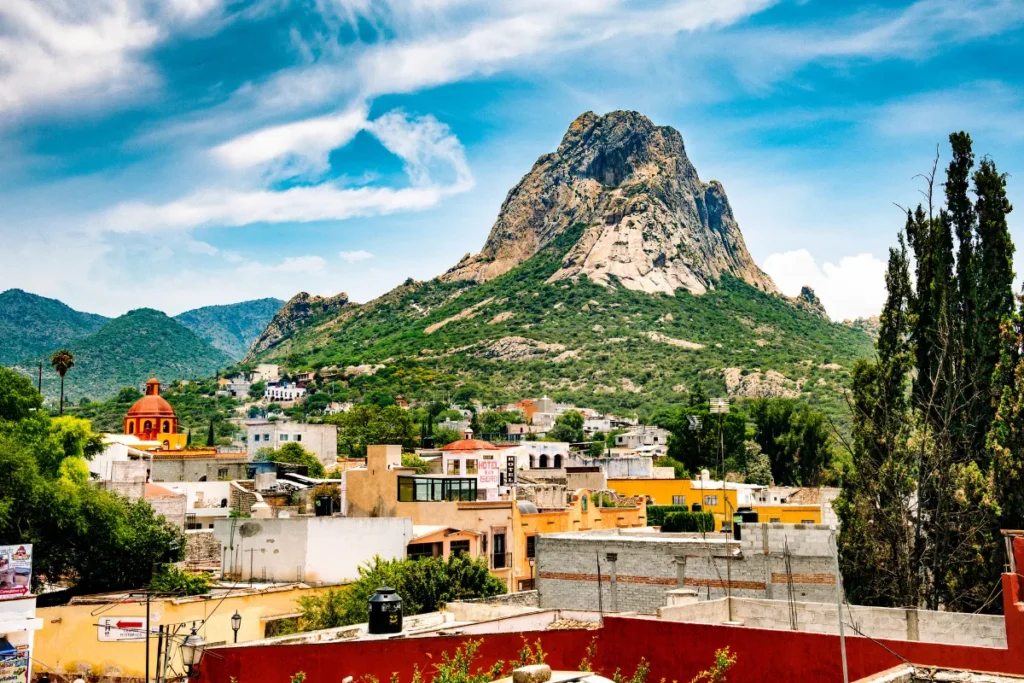
The vibe: This is where Mexico’s cultural depth lives. Mexico City alone has more museums than any city in the Americas. Oaxaca is the food capital — not just of Mexico, but arguably of the continent. Guanajuato is a university town built into a hillside, all painted facades and underground streets. San Miguel de Allende is colonial architecture preserved in amber, with a large and well-established expat community. Puebla is a working city with a food scene and a fraction of the expat premium.
Cost: Mexico City is mid-range — a furnished one-bedroom in a good neighbourhood runs $800-1,400 CAD. We’ve done the full cost breakdown for Mexico City. Oaxaca City and Puebla are genuinely affordable, with one-bedrooms from $400-700 CAD. San Miguel de Allende is the outlier — heavy expat demand has pushed rents to $1,000-1,800 CAD, making it one of the more expensive places in Mexico for its size.
Best for: Remote workers who want city life, timezone overlap with North America, fast internet, and coworking spaces. Culture lovers. Anyone who hates heat and humidity. Foodies — the highlands have the deepest food traditions in the country. If you want help choosing a neighbourhood in CDMX, we’ve mapped it out.
The catch: The highlands are an earthquake zone — Mexico City sits on a former lakebed, and the 2017 quake is recent memory. Altitude adjustment is real: that first week, you’ll feel winded on stairs and sleep harder than usual. It passes, but it’s not nothing. And CDMX has smog days — the valley traps pollution, particularly in dry season. If you have respiratory issues, ask about air quality before committing. We cover safety in Mexico City in a separate guide.
The Pacific Coast: Beach Life with Real Towns Behind It
You’re sitting on a rooftop in Puerto Vallarta’s Versalles neighbourhood — not the tourist strip, the real one — watching the sun dissolve into the Pacific. There’s a plate of ceviche from the mariscos place downstairs, the one where the owner knows your order. The ocean is a five-minute walk. Your rent is less than a parking spot costs in downtown Vancouver. This is the Pacific Coast version of Mexico, and it’s the one that’s been drawing Canadian snowbirds south for decades.
The Pacific runs from Baja California Sur all the way down to Oaxaca’s coast, but the expat corridor is concentrated in a few key cities: Puerto Vallarta, Mazatlán, Sayulita, and La Paz in Baja. The climate is tropical — warm to hot year-round, with a pronounced rainy season from June through October that brings humidity, afternoon downpours, and the occasional hurricane scare.
The cities: Puerto Vallarta, Mazatlán, Sayulita, La Paz (Baja California Sur).
The vibe: Beach life, obviously — but the Pacific cities aren’t just resorts. Puerto Vallarta has a year-round local population of over 300,000 and a downtown that functions as a real city, not a tourist set piece. Mazatlán has been reinventing itself with a restored historic centre and lower prices than PV. La Paz is quieter, drier (it’s desert coast, not tropical), and draws sailors, divers, and people who want a smaller-town feel with ocean access.
Cost: Puerto Vallarta is mid-range, with furnished one-bedrooms in non-tourist neighbourhoods at $900-1,400 CAD. Zona Romántica and the malecón area carry a tourist premium. We break it all down in the Puerto Vallarta cost guide. Mazatlán is more affordable — comparable apartments run $600-1,000 CAD. La Paz falls somewhere in between.
Best for: Retirees who want warmth, beach access, and an established Canadian community. PV has direct flights from Toronto, Vancouver, Calgary, and Montreal in season. Private hospitals are accessible — several in PV are within 10 minutes of the main neighbourhoods. If your priority is “ocean, sunshine, and a community of people who speak English and share my frame of reference,” the Pacific coast delivers that more reliably than anywhere else in Mexico.
The catch: Humidity. June through October is genuinely uncomfortable if you’re not built for tropical heat — 30-35°C with humidity that makes 30 feel like 40. Hurricane season is real, and while direct hits on PV are rare, it reshapes insurance costs and peace of mind. Peak-zone pricing means the most walkable, photogenic areas cost 30-50% more. And the Pacific coast can feel transient — communities cycle with the seasons, and the person you have coffee with in January may be gone by April.
The Gulf and Yucatán: Safety, Heritage, and Caribbean Light
In Mérida, the mornings start early. By 6 AM the mercado is alive — vendors stacking towers of habaneros, the smell of cochinita pibil already drifting from the stalls. You walk through the Centro Histórico on streets the Spanish laid out in the 1500s, past a cathedral built on the stones of a Mayan temple, and the light has that particular Gulf quality — bright and heavy and golden. By noon it’s hot enough that the whole city retreats indoors. By 5 PM it stirs again, and the parks fill with families and ice cream carts and the particular sound of a city that’s been doing this for centuries.
The Gulf coast and Yucatán Peninsula are Mexico’s eastern edge — Caribbean access, Mayan heritage that predates everything the Spanish built, and some of the most affordable living in the country. The big draw for Canadian expats is Mérida, which has built a reputation as one of the safest cities in Latin America with a cost of living that makes your pension feel twice its size.
The cities: Mérida, Playa del Carmen, Tulum, Cancún (as a residential base — not the hotel zone).
The vibe: Split personality. Mérida is colonial, cultural, safe, and largely untouristy despite its growing expat community. It’s a city of a million people where daily life is shaped by the families and communities who’ve been here for generations. The Caribbean coast — Playa del Carmen, Tulum — is a different animal entirely: younger, international, beach-centric, and increasingly expensive. Cancún’s residential neighbourhoods are functional and affordable but lack the charm of Mérida or the beach culture of Playa.
Cost: Mérida is the value anchor — furnished one-bedrooms from $650-1,000 CAD in good neighbourhoods. We have the full Mérida cost breakdown. Playa del Carmen has a growing expat premium, with comparable apartments at $900-1,400 CAD and climbing. Tulum is expensive — $1,200-2,000 CAD for a one-bedroom, and the infrastructure doesn’t justify the price. Cancún residential areas run $700-1,100 CAD.
Best for: Retirees who prioritize safety and affordability — Mérida is the strongest option in Mexico on both counts. We cover Mérida’s safety profile in detail. The Yucatán also suits anyone drawn to Mayan heritage, cenotes, and Caribbean access (the coast is 30-45 minutes from Mérida). Playa del Carmen draws younger expats who want beach lifestyle with more nightlife and international community than Mérida offers.
The catch: Heat. Mérida summers are intense — 35-40°C with humidity, and your electricity bill will reflect it. Air conditioning is a line item, not an afterthought. Budget $80-200 CAD/month for electricity alone in peak summer. Mosquitoes are a year-round presence on the peninsula. And the Caribbean coast faces gentrification pressure — partly driven by international demand for short-term rentals — that’s worth understanding before you commit.
A Note on Tulum
We should be honest about Tulum. The “off-grid boho wellness retreat” image hasn’t matched reality for years. A one-bedroom costs more than Mexico City, the beach road is a traffic-clogged strip of overpriced restaurants, and rapid development has outpaced infrastructure — water shortages, sewage problems, and a housing crisis that’s displaced local residents as international short-term rental demand reshaped the town. The cenotes are still stunning and the coastline is still beautiful, but the cost, the crowds, and the ecological pressure make it a poor choice for anyone planning a long-term, affordable life in Mexico. If the Yucatán appeals to you, look at Mérida first.
Region Comparison: The Quick View
| Region | Climate | 1BR Rent (CAD/mo) | Safety | Best For | Biggest Trade-off |
|---|---|---|---|---|---|
| Central Highlands | 12-27°C, dry, cool nights | $400-1,400 | Varies by city | Remote workers, culture lovers, foodies | Earthquakes, altitude, air quality (CDMX) |
| Pacific Coast | 30-35°C, humid, rainy Jun-Oct | $600-1,400 | Generally good in expat areas | Retirees, beach lovers, Canadian community | Humidity, seasonal pricing, transient feel |
| Gulf / Yucatán | 30-40°C, humid year-round | $650-1,400 | Mérida among safest in Mexico | Retirees on a budget, safety-first, heritage | Extreme heat, high electricity, mosquitoes |
Our Picks by Lifestyle
For retirees: Mérida (Gulf) or San Miguel de Allende (Highlands). If you want safety and affordability, Mérida wins — your pension goes furthest here, the city is walkable, and the expat community is growing but hasn’t driven prices up the way San Miguel has. If you dislike heat and humidity and have a slightly larger budget, San Miguel gives you spring weather year-round with a deep, established expat community. Both are excellent. The deciding factor is whether you’d rather reach for sunscreen or a light sweater.
For remote workers: Mexico City (Highlands). No contest. Timezone overlap with Eastern and Central North America. Fibre internet. Hundreds of coworking spaces. A food scene that would take years to exhaust. A social infrastructure — meetups, communities, events — that no other Mexican city matches. The altitude takes a week to adjust to. After that, it’s arguably the best remote-work city in the Americas. Here’s our guide to CDMX neighbourhoods for expats.
For beach lovers: Puerto Vallarta (Pacific). Established, safe, strong Canadian community, direct flights home, good hospitals. It’s not the most affordable option, but it’s the most complete package for someone whose priority is ocean access with infrastructure you can trust. Read the full PV cost breakdown to see what your budget gets you.
For culture: Oaxaca City (Highlands). The food capital of Mexico — possibly the Americas. Markets, mezcal, textiles, indigenous heritage, art, and a creative community that draws people from around the world. It’s also genuinely affordable — one of the best value propositions in the country. Less touristy than San Miguel, less overwhelming than CDMX, and at an altitude that keeps the heat manageable.
How to Narrow It Down
Ask yourself three questions:
1. Can you handle heat? If the answer is “I left Canada because of cold, not to find more sweat” — the highlands. If you want warmth but can take humidity — Pacific coast. If you’ll run the A/C all day and not complain about the electricity bill — Gulf.
2. What’s your budget? Under $1,500 CAD/month and you want comfort — Mérida, Oaxaca, or Puebla. $1,500-2,500 CAD — Mexico City, Mazatlán, or Cancún residential. Over $2,500 CAD — Puerto Vallarta, San Miguel, or Playa del Carmen, where the premium buys you established infrastructure and expat community.
3. What does your ideal Tuesday look like? Working from a café in a colonial courtyard? Highlands. Morning swim, afternoon reading on a terrace with an ocean breeze? Pacific. Walking to the mercado at dawn, spending the hot afternoon in a house with thick colonial walls and a ceiling fan, evening stroll when the city comes alive again? Gulf.
Mexico doesn’t ask you to choose between affordable and interesting. It asks you to choose which version of interesting you want. The answer is personal, and there’s no wrong one — just different trade-offs. Start with a month somewhere. You’ll know quickly whether the region fits.
Plan Your Move
Once you’ve picked your region, the real planning starts — visas, housing, banking, healthcare, and the hundred small decisions that turn a vacation into a life. Our Mexico Relocation Kit walks you through all of it, step by step, with costs in Canadian dollars and none of the guesswork.
Immigration rules, visa requirements, and costs change. The information in this guide reflects conditions as of early 2026. Verify all legal and financial details with official sources or a qualified professional before making decisions.