This post contains affiliate links. If you purchase through our links, we may earn a small commission at no extra cost to you. We only recommend services we’d use ourselves. Full disclosure here.
Is Mérida Safe for Canadian Expats? What You Need to Know (2026)
By Taraji Abroad
Mérida doesn’t need spin. It doesn’t need a “but actually it’s safe” defence or a carefully worded caveat. The Yucatán capital is genuinely one of the safest cities in Latin America — and the data backs it up. Mérida’s homicide rate is a fraction of Mexico’s national average, lower than many mid-sized Canadian cities, and the Yucatán state consistently ranks as the safest in the country.
That’s not marketing. That’s the actual story.
If you’re a Canadian considering Mérida — especially if you’re retired or planning to be — the safety question is the easiest one to answer. The harder ones are about heat tolerance and whether you can handle a slower pace of life. We’ll get to the practical details, neighbourhood by neighbourhood, but the headline is simple: Mérida is one of the safest places a Canadian could choose to live abroad.
All costs in CAD. Information current as of early 2026 — verify details before making decisions.
How Safe Is Mérida Compared to Canadian Cities?
Walk down Paseo de Montejo on a Sunday morning — families out, kids on bikes, elderly couples on park benches — and Mérida feels less like the Mexico your relatives worry about and more like a sunnier version of a quiet Canadian city.
The numbers support that feeling. Mérida’s violent crime rate is comparable to cities like Ottawa or Halifax. The Yucatán peninsula is geographically and culturally distinct from northern Mexico — the drug cartel violence that dominates headlines about the country is concentrated in specific states, most of them over a thousand kilometres away. Mérida is closer to Havana than it is to the U.S. border.
Property crime exists, as it does everywhere. Petty theft, the occasional car break-in, phone snatching in busy areas. These are urban realities you’d navigate in any city — Winnipeg, Montreal, Mérida. The difference is that Mérida has significantly lower rates of violent crime than most of those Canadian cities.
Mérida’s crime statistics tell a specific and reassuring story — violent crime rates on par with or lower than most mid-sized Canadian cities.
Neighbourhood-Level Safety
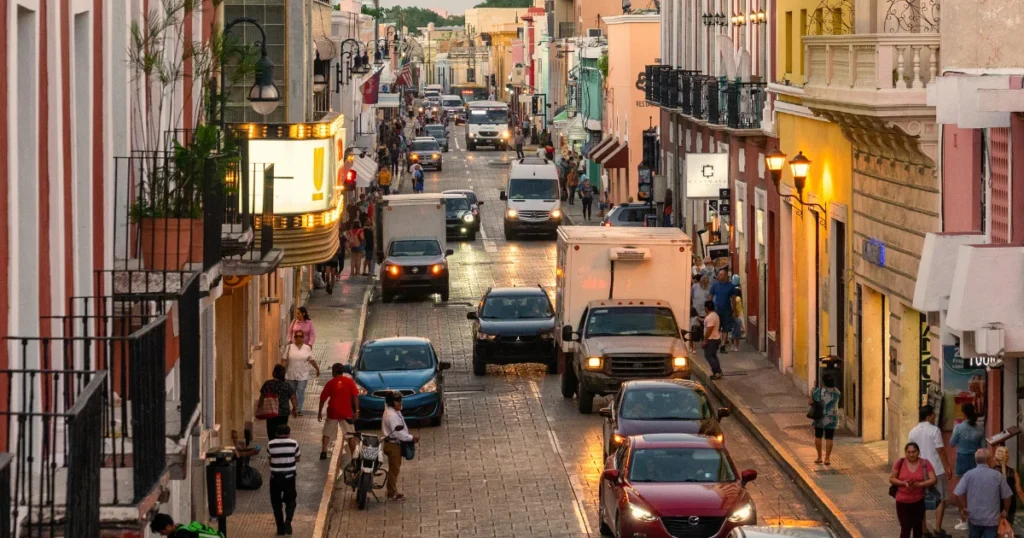
You’re standing in the centro on a warm evening, the cathedral lit gold against a darkening sky, and a brass band is setting up in the main plaza. A few blocks in any direction, the streets are calm and walkable. That’s the thing about Mérida — the whole city feels approachable, not just the tourist pocket.
That said, neighbourhoods have different characters.
| Neighbourhood | Safety | Character | Night Feel | Best For |
|---|---|---|---|---|
| Centro Histórico | ★★★★☆ | Colonial core, markets, restaurants, cultural heart | Lively and well-lit on main streets; quieter side streets after 10 PM | Walkability, culture, being in the middle of everything |
| Santiago | ★★★★☆ | Residential barrio with its own plaza and church, a short walk south of centro | Quiet, safe, residential feel | Retirees who want centro access without centro noise |
| García Ginerés | ★★★★★ | Established residential neighbourhood, tree-lined streets, mix of families and professionals | Very safe, residential quiet | Longer stays, families, retirees wanting comfort and calm |
| Paseo de Montejo / Colonia México | ★★★★★ | The grand boulevard — museums, upscale restaurants, beautiful architecture | Safe, well-lit, patrolled | Anyone wanting the most polished part of the city |
| North Mérida (Altabrisa, Montes de Amé) | ★★★★★ | Modern development, malls, gated communities, new construction | Very safe — designed for car traffic, less walkable | Families, those who want a newer, suburban feel |
The honest picture: Mérida doesn’t have neighbourhoods we’d tell you to avoid. Some areas south and east of the centro are lower-income and less maintained — you wouldn’t typically rent there as a newcomer — but they’re not dangerous in the way that word gets used about other cities. Mérida’s baseline is just high.
For a deeper look at what each neighbourhood costs, see our cost of living in Mérida guide.
What to Be Aware Of
Every city has things to be smart about. Mérida’s list is short and familiar — none of this is specific to Mexico.
Petty theft. Phones and bags, mostly. In busy markets or during festivals (Mérida has a lot of festivals), keep your bag in front of you and your phone in your pocket. Same advice you’d follow at the CNE or a Canada Day crowd.
Car break-ins. If you rent or own a car, don’t leave valuables visible. This is a universal urban habit, not a local warning.
Overcharging. Taxi drivers and some market vendors may quote higher prices to obviously foreign customers. This isn’t a safety issue — it’s a negotiation issue. Use ride-hailing apps (Uber works in Mérida, and InDriver is popular) for transparent pricing. At markets, learning even basic Spanish phrases goes a long way. Most interactions are friendly and fair.
Traffic. Mérida drivers are more assertive than what you’re used to in most Canadian cities. Intersections work differently — right of way is negotiated in real time. If you’re driving, pay attention at roundabouts and unmarked intersections. If you’re walking, cross with other pedestrians rather than alone, and make eye contact with drivers before stepping off the curb.
That’s genuinely the list. There’s no section here about violent crime targeting expats because it isn’t a pattern in Mérida.
Walking and Getting Around Safely
The centro is flat, compact, and walkable. You can cover most of it on foot in 20 minutes, and the grid layout makes it hard to get truly lost — the cathedral is visible from most intersections and serves as a permanent landmark.
Walking. The centro and Santiago are excellent on foot during the day. Sidewalks are colonial — meaning narrow, sometimes uneven, and occasionally shared with motorcycles or vendors. Wear proper shoes. At night, the main plazas and restaurant streets stay populated and well-lit. Side streets thin out after 10 PM but rarely feel threatening — more sleepy than sketchy.
Buses. Mérida’s bus system is affordable (about $1 CAD per ride) and covers the city well. Routes can be confusing at first — they’re identified by neighbourhood name rather than number — but Google Maps has largely caught up with routing. Buses are safe and used by everyone.
Uber and InDriver. Both work reliably in Mérida. InDriver lets you negotiate fares, which can save a few dollars on longer trips. Either option is transparent and trackable — use them at night when you’d rather not walk.
Cycling. Mérida has been expanding its cycling infrastructure, and the centro is flat enough to make biking practical. Sunday mornings, the city closes several major streets to cars for cyclists and pedestrians — a tradition called Bici Ruta. It’s one of the best ways to see the city your first week.
Healthcare Access
If you’ve spent any time navigating a Canadian ER wait time, Mérida’s healthcare access will surprise you. Private hospitals here are modern, well-staffed, and a fraction of the cost you’d pay out-of-pocket in Canada — with shorter wait times.
Major hospitals:
- Star Médica Mérida — the city’s main private hospital, modern facility, English-speaking staff available
- Hospital CMA (Centro Médico de las Américas) — well-regarded for general and specialist care
- Clínica de Mérida — established private hospital with a good reputation
A private doctor visit runs approximately $40-80 CAD. A specialist consultation is $60-120 CAD. An ER visit without insurance typically costs $150-400 CAD — expensive enough to matter, cheap enough that it won’t bankrupt you.
Pharmacies. Farmacias Similares and Farmacias del Ahorro are on almost every block. Many medications that require prescriptions in Canada are available over the counter here. The pharmacies often have a doctor’s office attached — a quick consultation for minor issues costs about $5-10 CAD.
Emergency numbers:
- 911 — police, fire, ambulance (same as Canada)
- Canadian Embassy (Mexico City): +52 55 5724 7900 — for consular emergencies
- Canadian Consular Agency in Cancún: +52 55 5724 9795 — covers Yucatán, Campeche, and Quintana Roo (about 3.5 hours from Mérida)
- Mérida local emergencies: Red Cross ambulance 065, Municipal police 942-0060, Ayuntatel citizen line 924-4000
For a full breakdown of healthcare planning, see our health insurance guide for Canadians abroad.
Safety for Solo Women
The evening paseo — that slow, social walk around the plaza that happens every night — is one of those things that makes Mérida feel like a city built for being out in the world, not hiding from it. Solo women are part of that scene, locals and expats alike, and it doesn’t feel like an act of bravery. It feels normal.
Mérida is widely considered one of the safest cities for solo women in Latin America. Street harassment is notably less common here than in Mexico City, Guadalajara, or most larger Latin American cities. It’s not nonexistent — occasional verbal comments happen, particularly outside the centro — but the frequency is low enough that most solo women report it as a non-issue in their daily lives.
Practical habits:
- Share your live location with someone you trust (WhatsApp does this easily)
- Use Uber or InDriver for rides after 10 PM — not because the streets are dangerous, but because it’s just simpler
- The solo female expat community in Mérida is active and welcoming — Facebook groups and WhatsApp chats share neighbourhood updates, restaurant recommendations, and real-time advice
- Trust the same instincts you’d trust at home. Mérida rewards them — this is a city where your gut feeling and the reality usually match
Safety for Retirees
If you’re retired, your real safety concerns in Mérida aren’t about crime. They’re about heat, sidewalks, and how close the nearest hospital is. Good news: those are all manageable.
Heat. This is the single biggest health risk for retirees in Mérida, and it’s worth taking seriously. Temperatures regularly hit 35-40°C with humidity that makes it feel hotter. Heat exhaustion and dehydration are real concerns, especially for those on blood pressure or heart medications. Drink more water than you think you need. Schedule outdoor time for early morning and late afternoon. Make sure your apartment has reliable air conditioning — this is non-negotiable, not a luxury.
Sidewalks. Colonial cities are beautiful. Their sidewalks are not. Narrow, uneven, and sometimes missing altogether — the centro’s walkways were built for horses, not walkers with mobility concerns. García Ginerés and north Mérida have more modern, accessible infrastructure. If mobility is a factor, choose your neighbourhood with sidewalk quality in mind, not just charm.
Healthcare proximity. Choose a neighbourhood within a reasonable distance of one of the private hospitals listed above. In Mérida, “reasonable distance” is usually 10-15 minutes by car — the city isn’t large. Having a relationship with a primary care doctor before you need one is the smartest thing you can do in your first week. A private GP who knows your medical history, your medications, and speaks English (many do) is worth more than any insurance policy.
Community. Mérida has a large, established Canadian and American retiree community — one of the biggest in Mexico. This matters because it means infrastructure exists: English-speaking doctors who understand international patients, social groups, volunteer organizations, and people who’ve already figured out the things you’re about to figure out. You’re not pioneering anything here. You’re joining a community that works.
For a comparison of retirement destinations, see our Mérida vs. Mexico City for retirees guide.
Insurance — The One Non-Negotiable
Healthcare in Mérida is affordable. It is not free. And your provincial health card stops covering you the moment you leave Canada — or within a limited window, depending on your province.
A routine doctor visit won’t break the bank. But a hospital stay for a broken hip, a cardiac event, or a serious infection can run $5,000-20,000 CAD without insurance. It’s cheaper than the same event would cost in Canada out-of-pocket — but it’s still real money.
For stays under six months, travel medical insurance covers you. For longer stays, look at international health insurance designed for expats — these plans are built for people who live abroad full-time and cover local hospital networks.
We recommend SafetyWing for Canadians moving abroad. Their Nomad Insurance covers emergency medical, hospitalization, and emergency medical evacuation. For retirees, their Nomad Insurance Complete plan offers more comprehensive coverage including pre-existing conditions (after a waiting period). It’s one of the most affordable international health insurance options available, and it’s designed specifically for people living outside their home country.
Whatever provider you choose — get covered before you leave Canada. Not after you arrive. Not “once you’re settled.” Before you board the plane.
Read our full health insurance guide for Canadians abroad for a detailed comparison of options.
The Bottom Line
Mérida is not a city where safety requires a strategy. It’s a city where standard awareness — the same awareness you’d use in Ottawa or Victoria — covers you. The violent crime that defines Mexico’s reputation in Canadian media is concentrated in specific states, none of them the Yucatán. Mérida’s safety record is not an exception to the rule; it’s a different reality entirely.
For retirees, Mérida is one of the strongest choices in the Americas — safe, affordable, with excellent healthcare access and an established expat community that makes the transition smoother. For solo women, it’s one of the most comfortable cities in Latin America. For remote workers, the worst thing that’s likely to happen to you is a sunburn.
The real question isn’t whether Mérida is safe. It’s whether you can handle the heat.
Planning your move? Start with our cost of living breakdown for Mérida and our Mexico City safety guide if you’re comparing destinations.
Disclaimer: This article is for informational purposes only. Safety conditions can change. Always check the Government of Canada travel advisories before travelling. We are not responsible for decisions made based on this information.